Blog Archive

Wednesday, September 7, 2022

Pune Ganesh festival darshan - a walk through devotion, traditions and history of the city

 Started from home at 6:30 AM and after parking our vehicles as close to Kasba Peth as possible, the walk for darshan began. This is a special year as we take Kirin for Pune Ganesh darshan for the first time, considering lockdown of last 2 eyars.

In this post, you will find that I have mentioned the order in which we took the darshan and a brief information about the various Ganeshas we visited.

1. Kasba Ganpati: When Raajmata Chh. Jijabai and Chh. Shivaji Maharaj came to Pune and started residing in Lal Mahal, there was a self-formed (swayanbhu) idol of Ganesha found in a nearby plot. Jijabai built the Kasba temple to host this Ganesha idol. Worshipped by many across generations including all Peshwa rulers, this temple is regarded as the Patron god (gram devataa) of Pune.

Ganesh murti established by the mandal (committee) of this temple was regarded as the most revered (maanacha pahila) by Lokmanya Tilak who started the Ganesh festival in the year 1893.

We started our journey by first visiting the Kasba Ganpati temple and then the Kasba Ganesh mandal maanacha pahila (first) Ganpati in their pandal outside the temple.


2. A year before Lokmanya Tilak decided to take Ganesh festival public, Bhausaheb Rangari started celebrating Ganesh festival outside premises of private compounds and without any restriction on visitors. While Lokmanya Tilak is attributed to make Ganesh festival public and on a national scale, eventually uniting people for cause of freedom struggle; Bhau Rangari is considered to be first person who celebrated the Ganesh festival publicly and made it accessible to the commoners.
This was the second Ganesh we visited. Reached here just in time for morning aarti and attended the entire aarti.


3. Regarded as Patron goddess of Pune for many centuries, Tambdi Jogeshwari is an ancient temple of goddess in Pune. Chh. Shivaji Maharaj started his Pune reformation after seeking blessings of this goddess.

Ganesh murti established by the mandal (committee) of this temple was regarded as the second most revered (maanacha dusra) by Lokmanya Tilak who started the Ganesh festival.

The Tambdi Jogeshwari goddess temple and the Ganesha darshan in the adjacent pandal was our third stop.


4. Third most revered (maanacha teesra) Ganpati by Lokmanya Tilak was the Guruji Talim Ganesha.

Guruji Talim as the name suggests was a gym, open to all religions and castes, and 5 years before Lokmanya Tilak decided to start Ganesh festival, 3 prominent members of the gym - Bhiku Shinde, Nanasaheb Khasgiwale and Shaikh Kaasam Wallad decided to start celebrating Ganesh festival in the gym. While this was a member's only celebration with the gym, it was and excellent example of people of different religions coming together to celebrate the Ganesh festival.
After Lokmanya Tilak made the Ganesh festival public, he designated this Guruji Talim Ganesha to be the third most revered in Pune, to honor the early inception and celebration of communal unity that the members were doing for 5 years already. Even today, this mandal represents the same spirit, although the gym is no longer in operation.

This was the fourth Ganesha we visited.


5. Next up was the Tulsibaug Ganesha, establised a few years after Lokmanya Tilak started Ganesh festival but soon gaining popularity and prominence due to participation of various factions of community, owing to the fact that Tulsibaug has been a popular market place for more than a century now. It soon earned its place as fourth most revered (maanacha chautha) Ganpati.

After visiting this Ganesha, we had our breakfast around 9:30 am.


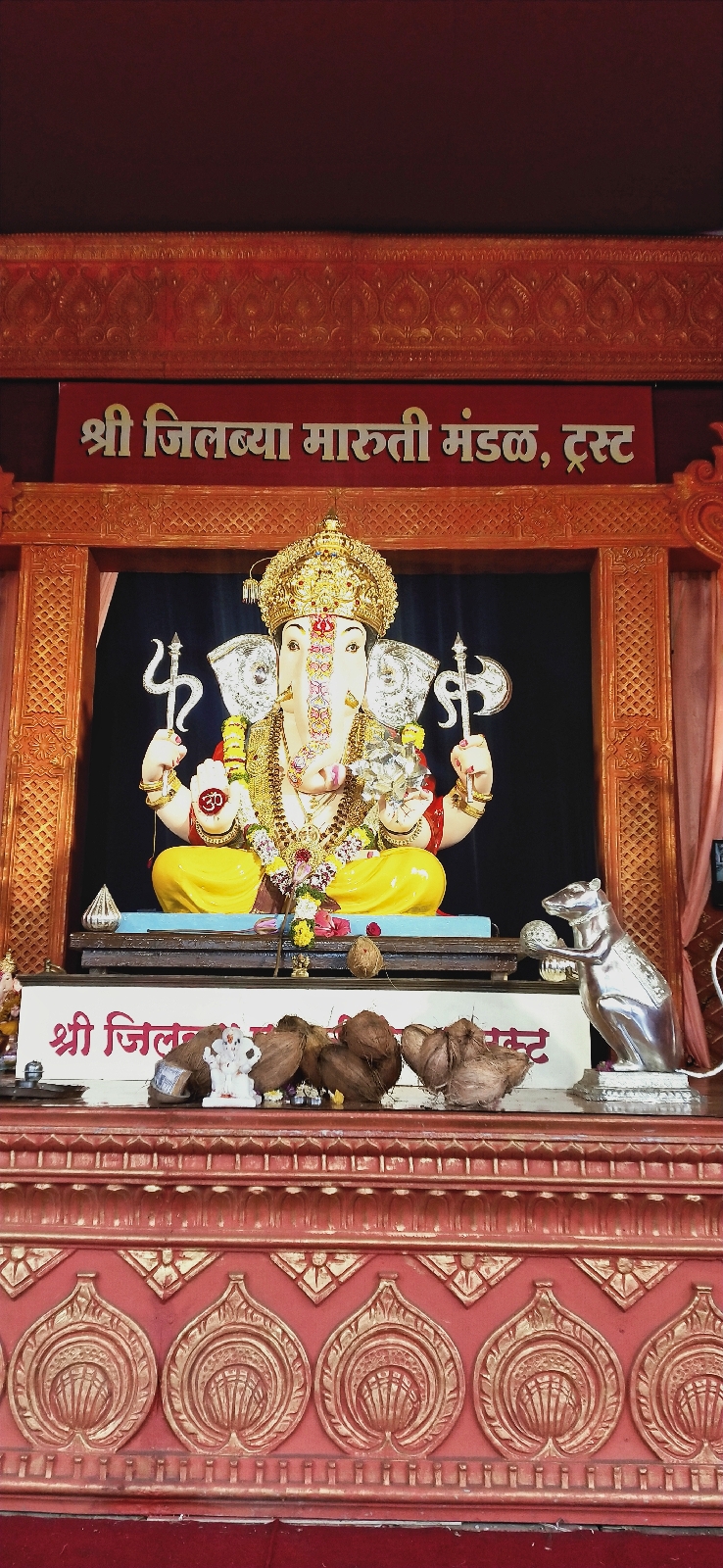
A beautiful Ganesha surrounded by flower decoration that looks like Balaji face from a distance at entrance of Tulsibaug and the Jilbya Maruti Ganpati at the exit are also worth visiting.

6. It was now time to switch from Maanache (revered) Ganeshas to the popular Ganeshas.
First one after Tulsibaug was the Shaarda Ganesh in Pune Mandai i.e. central vegetable market. Popular among devotees and a very very beautiful Ganesha, with amazing decoration is a must-have experience.


7. After Shaarda Ganesh, it was time to visit the Hutatma Babu Genu Ganesha. This Ganesha is known to fulfill your wishes and people flock with threads to bind their wishes and coins to try their luck with wishing well here.
This was our next stop.


8. Soon after, we came to probably the most famous Ganesha of Pune in current times - the Shrimant Dagdusheth Halwai Ganpati. Took Darshan from a distance looking at the queue and moved on to our final stop by getting an auto from nearby road.


9. Fifth among most revered Ganeshas (maanacha paachva Ganpati) is Kesari wada Ganpati.
Started as part of making the Ganesh festival public in Kesari premises by Lokmanya Tilak himself, this Ganesha is a simple yet elegant representation of the festival and it's humble beginnings. You can sense the presence of Lokmanya Tilak around here with all the stories and pictures depicted within the Kesari wada.


With this we completed the most auspicious five Ganpati and also some popular Ganpati of Pune in our walk. Not to mention many more on the roads and alleys that we walked on.
It was 12:15 pm when we reached home.

Monday, August 19, 2019

a drop in an ocean

Have you ever been there?
where you decide to explore how far a wish of your takes you? and you get positively and pleasantly surprised by the response it receives?

Well, when Santosh Pawar asked in our KBP college batch group if we can do something for flood (2019) victims in western Maharashtra, it was just another thought. Somehow, it resonated with a few of us, and we decided to go with it.

As we wanted as much fund as we could collect to help the flood victims, I spread the word in my office group as well.

Within a week, we had 29,500 INR collected from my office colleagues and 54,950 INR collected from my college friends. My wife and her close friend since school days also contributed 5,000 INR each and we had a total of 94450 INR as a collection (I split my collection to double-hat in both CS and KBP groups :-P)

Collection details:


All of us were firm on the thought that we do not wish to just dump more of same things in some government or ngo office/camp, we wanted to help the needy by directly handing over useful goods to them. So, based on the collection that was flowing in, and feedback we were receiving from volunteers working in flood affected areas on a daily basis, we decided to make packets of grocery, medicine and inner-wear, such that one packet serves to help one family of 4-5 people get through at least a week or two.

Depending on the money we were to receive, we decided to just keep increasing number of such packets, to help more and more families.

Grocery was ordered through our mutual wholesaler friend in Satara, Anand Bhatia; Medicines through our doctor friend Dr. Tejas Patil from Satara, and we bought the undergarments from a wholesaler in Pimpri market.

Here is what we bought as part of one packet:


Here's the summary sheet to tie the contributions to expenses:


We were in touch with a local volunteer Aniket and also my friend's brother Dr. Tejas was already part of medical camps in Sangli. Two of them helped us scout for people who were yet to receive any aid, even after 8 days of flooding in their village.

We created 60 packets of supplies and chose the 'Khanai Malaa' hamlet on outskirts of Inaam Dhamni village on Miraj-Sangli road to go and distribute it on 18th August 2019. This place had a population of 62 houses, mostly of workers employed in near by brick kilns, who were already poor and had now lost most of they had, in the floods. The water level in their houses was 8 feet high for 3 days during flooding. They had to vacate and take shelter away from home and missed some of the initial help that was supplied by many in the initial days.

KBP gang of my classmates Santosh Pawar, Tushar Patil and his friend Vijay Nikam, Mallikarjun Bansode, Prasad Dalvi (myself), Nilesh Mudgal and his brother Nikhil, and Dr Tejas Patil (brother of Tushar) decided to go in person to distribute the goods. We were accompanied by a local gram sevak of Inam Dhamni Mr. Sutar. He had already extracted a list of one name per household with details of how many people are part of each of these household, so that we can track if every house has received the packet, and that nobody comes back for a repeat.

As we were carrying more medicines, we handed over the remaining 40 packets of medicines to Dr. Tejas, so that he can use them in his next camp in the flood affected region. This way we managed to reach even more people, although indirectly.

This activity was our drop of contribution in the ocean of help, that entire India is doing for the western Maharashtra region, to help it recover from the floods.

Some pictures of our visit below:


A list of our beneficiaries was ready by the time we were done with the distribution, thanks to pro-activeness of Mr. Sutar. Sharing it here as well.


More pictures and videos in google photos album:
https://photos.app.goo.gl/J6ymad3SbMfhTbVu8

At the end of our activity, we left a smile on face of 60 families, who needed a reason to believe in humanity, who wanted a ray of hope to rebuild what is lost and who have endured so much loss in a single natural disaster.

Here's hoping that we (KBP friends) can come together for more such causes [and sometimes, for the old times sake, also without any cause :-) ], to keep nourishing the bond of friendship we have since we were teenagers. Also, hoping to keep receiving similar support from my office friends and colleagues for helping the needy.

- parsooram

Friday, October 5, 2018

Finding Neverland


Have you ever been there - when no matter how much you are rested, and how much you are at peace with your surroundings, you just feel the craving to ditch the routine and ditch the regular faces - family, friends and colleagues alike, and just want to ride to a land of serenity far far away !!

Well, a similar ball park - but of course, the ditching part doesn't apply to the wifey - so, it was two of us - who made a random decision to go riding a bike to Kaas Plateau. As Satara is my home town, we took the ride on evening of earlier day until my home, and then went to the mountains and the plateau next day morning.

And there it was - a plateau spread across multiple miles, blooming with wild flowers of different varieties, covered in shades of yellow, white, purple, pink and violet patches all over; plus there was the Kumudini lake covered all over with white lotus flowers - all-in-all a good place to visit.

But that's not why I am posting this blog - there is more to this experience.

When we are going to any touristic and crowded place in India, in general, there are a few observations - and this place, this spot right in my hometown defied so many of those conventions - and that's the reason for this post.

When you are trying to earn your livelihood in Hinjewadi, often times, you hear the power phrase "I am local" - may it be in some brawl on road for incorrect driving or may it be in some queue when somebody skips it - of course, it is a general phenomenon everywhere - from temples to tourist places - people just love to use the L word to show their influence and power over others. Well, welcome to Kaas plateau - where everyone is a tourist and needs a visitor booking done online to get through - where no one is going too close to flowers just because they are locals and no one is hustling the guards and fellow tourists using the L word. +1 to the happiness.

Then there is a fact that for all those miles - and we walked at least 4-5 miles on both sides of the road, there was not a single piece of garbage - paper, plastic, bottles, empty water bottles or snack packets - nothing seen. For a place which sees thousands of visitors daily, in India, this was another major plus we observed. A clean and green plateau - sounds fantastic, ain't it. +1 again to the happiness.

In fact, the locals have taken it to the extent where the food that is sold, is brought in small steel containers and leftovers are taken back in the same, and is only cucumbers, Nachni bhakri, pithla and some buttermilk/lime water. There is no food like the usual touristic bhuttas which create a lot of garbage. Not to mention, the homegrown Nachni by local villagers using their crude farming techniques is as close as you can get to the urban longing of "organic" food; plus, those who follow Rujuta Divekar for diet tips would be overwhelmed with joy eating Nachni bhakri for breakfast. +1 and +1 again, isn't it?

This food sold by women of local villages and hamlets plus the fact that most of the guards employed here are local elderly men also assures that the people from surrounding places get some earnings out of this whole touristic affair, even if it's seasonal in nature. +1 to that too as well readers !

And the part which I love the most about these mountains surrounding and shadowing my home - a few kilometers of ride and you enter a world of fresh air, serene nature, lush greenery, calm weather - your mind can't help but to relax itself. It sets itself on auto-pilot when it comes to getting relaxed. That happened to us too. May be that is why I took up blogging again after such a long gap. So, another +1 to the happiness.

And then there were people actually caring about the nature and about fellow humans that we saw - making sure there are no selfies taken at dangerous places, making sure that there is water available after long walks, making sure that those who seek information get to know about the flowers and the place, and of course, the occasional voices among tourists of - "hey, don't touch the flowers, let us retain this nature's gift for the future generations to enjoy" ! Wow ! yes, people do care. +1 for that too.

What started as an attempt to just go away from the urban routines of back stabbing and politics and  exhaustion, soon turned into a celebration of happiness - I was happy to be at the place, and enjoy the flowers and the view and all the good things about the place - I was happy that this place in my home town was making me so happy - I was happy just breathing the magical air on the plateau.

So, a place - which was far away from the city noise, a place where people talked with sanity and care, a place where there was no electronic interference thanks to the less network coverage, a place where air was clean and mind was relaxed, a place where food was delicious and nutritious at the same time, a place where the landscape was full of bright colors all over and green meant an array of different colors, a place where even the tiniest wild flower understood that to make an impact, it has to stay close to many others like it, and that culminated in such a natural beauty - and that place is Kaas Pathar, in Satara.

What can I say, this time around, when I went home, I found my Neverland :-)

- Parsooram

(Pictures that we took in this place can be found in the flickr link: https://www.flickr.com/photos/94951116@N04/albums/72157701803239284 )

Friday, May 8, 2015

A trio of Politics, Economics and Vision: #NaMo in a year

Well, soon the Narendra Modi [#NaMo] government in center will complete it's one year, and there will be news and claims and anti-claims from all political outfits of the nation. I am an analyst, and I like to believe in numbers, I look for events, policies, procedures and impact that these numbers relate to. Hence, before the noise about our 'PM on flight mode' begins in news media and social media, I thought of checking out a few numbers myself. And then ofcourse, post a blog about it :-)

And yes, before we begin, as the title of this post suggests, I am trying to focus on two aspects of every set of numbers [three sets, to be accurate], the politics of it and the economics of it; and these together provide us a decent picture of the vision behind each of these initiatives.

A) Lets start with my personal favorite - The Prime Minister Jan Dhan Yojana.
Here are the real numbers as of 31st Jan 2015.
Total Number of Bank Accounts opened: 12.5473 Crore
Total Number of Zero Balance Accounts: 8.44 Crore [around 75%]
Total Number of Rupay Debit Cards distributed among these accounts: 11.07 Crore
Total Account Balance in these Accounts: 10499.62 Crore Indian Rupees
So, what do these numbers suggest?
Politics of it all:
1) 11.07 Crore families will now have an Accident Insurance cover of 1 Lakh each. In other words, Social Security in case of accidents to 11.07 Crore poor families of India.
2) 12.547 Crore accounts of poor available for direct benefits transfer [D.B.T.], including 8.44 Crore accounts with zero balance during account opening. So, next time, there is fodder money to be allocated among the 7.5 Crore rural families that are part of this big number, no Laloo can indulge in a scam. The benefit will directly get credited to the deserving accounts through NEFT. Let me rephrase, this is another milestone towards corruption free allocation of benefits to the poor.
3) Active Inclusion of 12.5473 Crore poor families in the Financial System of the country, which was infact the publicised motto of this scheme anyways.
Economics of it all:
1) With the current financial situation of India, the prevailing interest rates, all the offers for easy loans and finance, any reforms undertaken by the government would not have created sufficient increase in household savings for the country. So, instead of going after the same old crowd and incentivizing them for doing additional savings [increase tax exemptions, etc], how about go look into the so-called grey economy/parallel economy of India, and bring these people on-board. And did this bold move work !! Well, we did get a whopping household saving of 10499.62 Crore Indian Rupees from people who never operated any bank account before, and that is a number just until Jan 2015. A master stroke if you ask me, to help reduce the current account deficit of our country.
2) One of the important fiscal policy tools for government is transfers - of benefits, subsidies, etc and the parasite of corruption was eating up a portion of these transfers, no matter what. With so many additional accounts now available for D.B.T., this fiscal policy tool will become more efficient now.

B) Lets move on now to another of my personal favorites - The Make in India initiative.
25 Sectors, Flagship Delhi-Mumbai Industrial Corridor [DMIC] project to create a global manufacturing and investment destination along 1483 km long corridor spanning multiple states, and 24 cities. Four other Industrial Corridors are also conceptualized to cover most of the country's geography.
Politics of it all:
1) This initiative when complete will achieve a reduction of gap in manufacturing sector that India is currently facing, and add more employment opportunities for the growing population of India.
2) For its success, the leadership of India needs to collaborate with foreign investors, make new friends abroad, provide incentives for boost in foreign direct investment, seek momentum at an international stage for increasing and sustaining inflow of capital and investments in India, develop bi-lateral ties in trade and manufacturing sectors with old and new friend-nations. This kind-of explains the Flight Mode, by the way :-)
Economics of it all:
If you ask me, this one initiative is the unicorn of supply side policies. Get more industries, increase production, increase skilled labor, foster entrepreneurship, reduce the red-tape of administration, improve transportation and infrastructure-in-general, all this and much more - that economists suggest as supply side policies, is targeted by this initiative. And it is a common agreement, that supply side policies if successfully implemented, help in creating a sustained improvement in the economy of the country.
[demand side economic policies deal with GDP, consumption, government spending, investments, etc while supply side economic policies deal with increasing production, lowering unemployment, etc to boost GDP for good and are usually long term policies.]

C) And now, the decision that many like to gossip about - decision to add excise on petrol-diesel rates to keep them the same, despite international collapse in rates
Yeah, some time in last few years, people got serious about the Shale Gas, the process of Fracking became available, and large deposits found of cheaper Shale Gas just screwed up the market for Petroleum products. Petrol and Diesel were getting cheaper everyday. But guess what, NaMo government decide not to follow trend of international rates so accurately, and in came additional excise, just equal to the latest fall in international rates. Net impact to general population - no change in petrol and diesel prices any more.
What will this achieve? As per the estimates, the two full stops put in November [1.5 INR for both Petrol and Diesel] and December [2.25 INR for Petrol and 1.00  INR for Diesel], will generate an additional 17000 Crore INR for the government. Those are the numbers.
Politics of it all:
1) Anyone who has been in Singapore would know about the COE concept for vehicles there. Basically, all owners of vehicles end up paying an additional amount while buying the vehicle, increasing the effective cost of vehicle, and this COE is imposed by the Singapore government to keep the number of vehicles and in turn the side effects of too many vehicles like traffic jams, pollution, etc under control. Now, think of India and think that Petrol price drops to 45 INR. Can you imagine the frenzy that this will create. With Car and Bike loans so abundantly available, so many more people will start buying vehicles just because the fuel is now cheap and affordable. Putting a restriction to falling prices of Petrol and Diesel - for me is the essential governance decision taken by NaMo and team.
2) This money is dedicated for developing 15000 km of roads. Just imagine that.
Economics of it all:
1) This will result in a reduction in government spending by 17000 Crore INR [otherwise needed for those 15000 km of roads], which also means a reduction of fiscal deficit by 17000 Crore, making our budget more balanced, and reducing the need for external borrowing by 17000 Crore.
2) One of the issues that economists all over the world state about India is the very low proportion of taxes that get collected, as compared to its overall GDP. This also means that the Indian government has to keep looking for new ways to match its revenue expectations and imposing consumption tax, service tax, value added tax, excise duty are all various means which it can use to this effect. If you ask me, I view this new excise levied more as a consumption tax than excise. If I am using more Petrol, I will pay more to the government - as simple as that. And this usage has been projected to add 17000 Crore INR more. Best part, this has been done swiftly, without getting involved into discussions like those on GST, etc.

Three different instruments of economics - one which will cover for current account deficit, other which will boost supply side economy, third which will cover for fiscal deficit.
Three different initiatives - one which will provide access to social security and banking services for one-and-all, one which will generate employment for many, one which will help build this country's infrastructure.
Three different decisions - one restoring faith in 'sabka saath sabka vikas' slogan, one showcasing dream about a better future, one displaying resolution in achieving fiscal targets.
Three different visions - one to build infrastructure of today, other to employ the youth of today and tomorrow, third to include everyone in this path to progress.

Yes, there are so many other initiatives and plans and scam free governance examples and recent announcements that we can talk about. But, for me, these three sum it all up.
On the question about how did NaMo and his team perform last year, I have my answers :-)

Friday, August 15, 2014

Top 5 most promising things in NaMo I-Day speech


Well, the Independence Day speech by Prime Minister Narendra Modi is all over the news anyways, and yes there were many things said this morning, but I had to publish my thought process about few of the things that I noticed to be promising for future of India as a nation:

1. A swift way to promote banking and to bring most of the India under banking and insurance infrastructure by announcing a free bank account with a debit card and an insurance of 100000 INR for even the poorest of the poor - the PM Jan Dhan Yojana. Direct visible impact - insurance to even the underprivileged, the Indian form of social security for the poor and the needy, and an increase in banking transactions and usage of debit cards. The promising future I see, may be India can afford to have its own banking transaction handling mechanism with all the increased volumes similar to NETS in Singapore. And even beyond this, this will convert so many transactions from the much-hyped parallel economy of India and bring them into mainstream, eventually leading to overall GDP growth.

2. The slogan of 'Make in India' and the related appeal to all Indians to use their entrepreneurial spirit and help reduce the imports of the nation by manufacturing indigenous products for domestic consumption is another promising announcement. Many experts believe that as India's rise in recent years was mainly due to growth in service industry and that it went from being a primarily agriculture based country to a country with growing service industry, skipping the essential phase of being the country with strong manufacturing industry, to sustain its growth in long term, it has to fill in this gap. Well, the invite to industries from all over the world to come and 'make in India' and at the same time, the encouragement to people of this country to manufacture something or the other, on whatever scale possible, is that bridge which NaMo has devised for the country. Not to mention the open appeal is inspiring for budding entrepreneurs planning to start their own small and medium sized industrial units.

3. Mandate to MPs, probably the first, and that too to make at least one village in their individual constituencies an 'Ideal Village' and increase this number to three by 2019. So, all round rural development through out the country is a mandate now. While use of gamification tactics like announcing the 'Ideal village' prize to villages meeting certain yardsticks of cleanliness, progress, creativity, education is part of older government policies; not restricting to just one ideal village per year in a state and making sure that there is at least three in each constituency emphasises the uniformity in progress of huge rural population of India. Connecting this plan and also the cleanliness mandate with the year 2019, when the nation will celebrate 150th birth anniversary of Mahatma Gandhi is work of genius, I would say.

4. Retiring the planning commission of India for a more inclusive economic policy making machine, robust enough to take in everything from modern ventures like  Public Private Partnerships (PPP) all the way to modern technology for optimum use of national and in particular the natural resources, is another promise for the better future. India will now have a holistic economic planning authority, created on the basis of current flat world realities of the international market, and current social state of its citizens. This is the part which I am most curios to know more about, and am looking forward to formation of this new organisation.

5. Crowd sourcing as many of us like to call it and Jan Bhagidari as NaMo referred to it - a promise of inclusion, a promise of using the masses to make impossible things possible, a promise of citizens giving back to the nation in one way or another, a promise of Indians coming together to make India a better place, is another interesting aspect that NaMo has brought in. 

Of course, there was also the fact that today's speech by NaMo was extempore, and he called himself a Pradhan Sevak, and his speech had an appeal to accept the girl child with equal love, and an appeal for Naxalites to start thinking about farming more than naxalism, and an advice for parents to do their jobs better especially with respect to upbringing of their sons so that they don't become rapists, and a quick whip to bureaucrats and an address to all nationals to remember the sacrifices of earlier generations and to not forget that this nation is built more by its farmers and workers and common folk, than it's leaders, but for me, the top five most promising things were the ones in bullet points above.

Wish you all a very Happy Indian Independence Day and a great weekend ahead.

Thursday, February 13, 2014

एक ठिगळलेलं आभाळ

आयुष्याचे रंग उधळता उधळता,
उगीचंच माझं आभाळ फाटलं.

आणि सर्वत्र दिसू लागल्या त्या बघ्यांच्या खोचक नजरा,
मित्रांचे बदललेले अंतरंग,
आणि गिधाडांची वाढलेली गस्त !!

मग ठरवलं, हे भगदाड मिटवून टाकायचं,
कष्टाची शिडी त्या आभाळापर्यंत बांधायची,
आणि आभाळालाही एक ठिगळ लावायचं !!

आज त्या आभाळावर एका हसऱ्या चेहऱ्याचा मुखवटा आहे,
उपरयांच्या नजरा आता अंतरंगात डोकावत नाहीत,
आणि प्रश्नांच्या उत्तरांना आता उगीचच फाटे फुटत नाहीत.

पण तरी मधेच केव्हातरी अंधारात,
निर्धाराचे टाके सैल पडतात,
त्यातून वाहणारी थंड, बोचरी हवा अंतर-विश्व गोठवून टाकते,
आणि पांघरुणात आणलेला शांत झोपेचा आव,
त्या ठिगळलेलं आभाळावाटे क्षणात नाहीसा होतो !!

-परसुराम


Sunday, August 11, 2013

घर..

घर. एक शब्द, दोन अक्षरे.
पण या दोन अक्षरात सामावलेला अर्थ शोधता शोधता संपूर्ण आयुष्य निघून जाते.

कोणी म्हणतो जिथे मी तिथे माझे घर, कोणी म्हणतो जिथे माझे आई-वडील ते माझे घर, कोणी म्हणतो जिथे माझी मुले-बाळे ते माझे घर. आजकाल व्हर्चुअल होम हि संकल्पना देखील फार उचलून धरण्यात येत आहे. या घराच्या जितक्या भिन्न व्याख्या, तितक्याच भिन्न परिसीमा.

"हे विश्वचि माझे घर .. " म्हणत संत महंत समस्त समुदाय आपलासा करतात, आणि "अपने घर मे तो कुत्ता भी शेर होता है" अशी डरकाळी फोडीत फिल्मी हिरो स्वतःआची छाप पाडतात.
विषयाचा आवाका मोठा आहे, पण फार लिखाण करणार नाहीये मी इथे; हो पण गेल्या काही दिवसात, जे काही विचार सुचले ते मात्र इथे नमूद करणार आहे.

जगाच्या एखाद्या कोपऱ्यात बक्कळ पैसा हाताशी असताना, तिथल्या अत्याधुनिक सोयी-सुविधा नियुक्त पोलीक्लीनिकच्या शेजारीच घर असताना देखील जर एखादी शिंक आली तर जीव आजारपणाच्या या विचारानेच का घाबरतो? हजारो किलोमीटर दूर आपल्या नातलगांना आणि बऱ्याचदा आपल्या मनाला देखील, आपण बळेच "मी ठीक आहे" असे सतत का सांगत राहतो?

आणि मग "घरी" आल्या आल्या सर्दी, पडसे, डोकेदुखी, ताप, थंडी, घश्याचे-दुखणे असे सगळे काही जरी एकत्र उद्भवले, तरी निर्धास्तपणे, रोजच्या रोज मिळणाऱ्या बिल्लमपल्ली डॉक्टरांच्या गोळ्यांच्या पुरचुंडीच्या बळावर, "दोन दिवसात बरे होऊ" असा विश्वास मनात कुठून उत्पन्न होतो?

जगभरातल्या लोकांना भारतीय जेवणाच्या नावाखाली काही मोजके, प्रसिद्ध आणि चमचमीत असे पदार्थ बनवून खाऊ घातले कि त्यांची वाह-वाही तर मिळते, पण त्या जेवणाच्या पानात कसलीतरी उणीव आहे, असे आपलेच मन आपल्याला का सांगत राहते?

आजारपण म्हटले कि पथ्य हे आलेच.  "तेलकट, तिखट, आंबट, गार काही खाऊ नको" आदेश झाल्यावर चार दिवस रोज वरण-भात-अर्धी भाकरी आणि अगदीच तोंडी लावायला म्हणून थोडीशी भेंडी, कारले, दोडका, कोबी अशी एखादी भाजी. गरम गरम असे हे जेवण आईने वाढले, कि एवढ्यानेच पोट भरून जाते. मनसोक्त "घरचे" जेवण वरण भाताच्या रुपात सुद्धा परिपूर्ण असते. या मागे आईच्या हातची जादू आहे कि घराचे घरपण ?

माझ्यासाठी जिथे माझे आई वडील तिथे माझे घर - असं समीकरण आहे. वर्षातून कधी मी घरी येतो, तर कधी माझ्या कामामुळे असलेल्या मुक्कामाच्या ठिकाणीच मला घरपण लाभते.

मागे कधीतरी एक इंग्रजी वाक्य वाचले होते. माणूस जे काही चांगले, वाईट काम करीत असतो, त्या मागे एकच ओढ असते, एकच अट्टाहास, घरी जाण्याचा..यातच घर या शब्दाची नवलाई दडलेली आहे, नाही का?

Friday, December 28, 2012

As bottom of the pyramid begins to shake !!

I KNOW !! There is that silver lining of suspense-thriller effect, which I have achieved in the title of this post itself :-D

Don't worry, this is not a Egyptian travelogue. In fact, this is about my readings, while I am sitting cozily at home, here in India.

And now, a few flashbacks, to facilitate my argument in this post, and to ensure the reader's familiarity with the topic :-)

"Flash One - The Leader Speaks"

I was browsing through the TV channels and suddenly I saw Nandan Nilekani speaking on something in "Hindi". Being an exfoscion, I had to stop and devotedly listen what he was saying. [Ex-foscion = Ex-Infoscion = Ex Infosys Employee]. While I don't recall the exact words now, what he was basically saying is that very soon, the ambitious Unique ID project will start integrating with public utility sector and government-subsidized supplies and with it the real value of Unique ID will be realized.

Some of you might already think, that we know that Unique ID is not accepted by most agencies as our identity proof, which establishes its importance already [:-P], but wait... Wait till I have finished with this write-up before reaching any conclusions.

"Flash Two - Knowing the Common Man"

Just last month, I went on to the Bharat Gas shop near my place and submitted "KYC" documents. The application form, among other details asked for Passport number, Unique ID [Adhaar Card number], Pan Card number, Bank account number and Domestic LPG Gas Consumer Reference number, and the whole exercise is to link all these "numbers" to one another at a central place. This is a small information matrix which is being populated everywhere in India, and once the year 2013 begins, the government subsidies for LPG gas would not be pre-deducted before consumers buy them, but this subsidy will now be deposited in our respective bank accounts, after we have already purchased the gas.

YES, there is still a chaos among politicos over how many cylinders will be at subsidized rate and how many will need full payment, and YES, there is a wide scope for appearance of another babu [govt official], who may control the release of subsidy amounts to individuals,  NOT TO MENTION the fact that the real Below-Poverty-Line folks will struggle to gather all the extra money required, but more about all of this later :-)

"Flash Three - The Pyramid"

Well, pick up a black and white Indian movie or even a color flick like Mr. India, and you will see him - "the classic villain", busy in black-marketeering and Adulteration of food-grains and groceries.
These villains became first publicly known corruption artists. I mean there were also Zameendars [the landlords], but these landlords were more about cruelty than adulteration and corruption.
So, if we think of the lifespan of corruption in India as a pyramid, the bottom of it was made by these beginners - the classic villains engaged in adulteration and black marketeering.
Then came the smugglers, smugglers of gold, of imported watches and what not. With them came the volumes of black money and with growing black money, came in the bhais and the politicos and the babus, all wanting their piece of the pie.
This new layer was built on the earlier base, so, it became the new high of corruption, while the earlier layer of adulteration got lost beneath the glamor of these new layers.

In blunt words, common people got used to getting grains mixed with pebbles, buying lesser-than-quota grocery from the subsidy shops due to "unavailability of sufficient stock", buying premium priced grocery from the same shops when there was an urgency of food, and all of this became an integral part of life. Adulteration and black-marketeering of food was a vice no-more.

With entry of Politicians and babus, the pyramid of corruption reached new heights. First the corrupt resorted to "commissions" for allocating contracts even in national defense deals; then they started getting "percentages" in distribution of things from fodder to houses; then came Harshad Mehta and he taught the corporate ways to all, making them understand how to "fit" 1 crore rupees in a suit-case. To top the corporate favors and lobbying, now comes another flavor of corruption - forget lowly tasks of distribution and approvals, we now have scams for "allocation" - allocation of 2G spectrum, of Coal Blocks, of government-reserved lands, and god knows how many things. This is the latest topping worth billions of rupees in the corruption pyramid of India and this pyramid has left the Egyptian creations way behind, when it comes to the "wonders of the world" effect!!

Anyways, enough with the flashbacks !! Lets begin the blog :-)
[I can only imagine the expression on face of my usual readers :-P]

So, one fine day, I began pondering about this whole Unique ID project, searched for more information on it and came across their website. Here, I came to know that this whole thing is surely not an initiative of any political outfit. It was proposed by the planning commission of India, way back in 2006, and is taking its shape ever since. Nandan is currently one of the leaders for this project.

Well, the project has its limitations as of today, considering the huge population which needs to be accounted for; but trust me. I have seen the effect, that having a single identification at all places can have. In Singapore, my Foreigner Identification Number, My National Library membership number, my Internet connection Subscription number, my Driving License Number, my blood donation card number, my poly-clinic registration number, are all the same. This has a convenience for me, as I don't need to keep a track of too many IDs, and it has a lot more advantages for the government. It can keep a track of what I have been up to, at any time!! If I default on my internet bill, it can also be linked to my Visa and that will make my life difficult for sure. Scary. isn't it? Just kidding :-)
Moreover, there is a certainty while accounting for every individual and that helps a lot while planning future for an entire nation.

Of course, the argument now is that it's possible for Singapore, but making it scalable for Indian population is a tough job. I know it is a tough job. Add to it, the complexities of races and religions and poverty-lines.

If I have to imagine an India with every person having his or her own Unique ID, I would see that the subsidy shop owners have no incentive anymore for adulteration of food, as they will get a premium rate for everything they sell. This also means no stock available for black marketeering. This implementation would shake the very base of India's corruption pyramid. It will bring transparency to the dealings that common man does. Not that It will stop the corruption, but the corrupt will move away from day to day dealings for basic necessities, in to the higher echelons.

If you have recently experienced the difference between dealings at Passport office up until last year, and the dealings at the out-sourced Passport Seva Kendras currently operating, you will know what I mean.

Although, I am not sure how the "Rice at 1 Rupees per KG" schemes and political announcements that spring during election times will work in this scenario :-P

The limitation to this entire shake-the-base-project, as per me, is that the Unique ID is still a "non-mandatory" document for Indian Nationals. i.e. Even if someone is not having a Unique ID, he or she can still get the same benefits as others, by quoting some other documents like the Passport or the Government allocated Ration Card. Keeping a track of so many identities will create chaos in maintenance and that can lead to gradual collapse or denial of the project.
Of course, as long as the central database can keep a track of all such identities, there is no issue at all; but nevertheless, this very non-mandatory nature of the Unique ID card is definitely a big challenge in complete implementation of Unique ID project itself.

Moreover, forget about the people who don't want this Unique ID out of their whims; my fear is Unique ID or no Unique ID, if the subsidized supplies are stopped and people are told to buy everything at premium price upfront and get a pay-back in their bank accounts later, it may create unrest among the real poor, who cannot afford to gather all that money at one go. There would suddenly be a stark difference in lifes-and-styles of the rich and poor and this is not very healthy for development of India as a nation.
I just hope this aspect is well thought of, while implementing various mandatory KYC projects all over the country.

Alright, I guess by now, I have already gloated all the readers with the write-up without really going any-where.

Well, the purpose was never to go anywhere; but sit back at this point in time, watch out the happenings in India around us, participate in the initiatives envisioned for a better nation building and make sure that we take everyone together with us, as we proceed, in unison.

Keep an eye out there people - the bottom of corruption pyramid is gradually shaking!!

Post Open for discussion and comments :-)

Saturday, March 3, 2012

Indian Politics: What to Demand of it ??

If you are an Indian, you will end up talking and hearing about Politics and Politicians of the country more often than you could ever imagine. I mean, when two or more Indian men come together for a casual talk, may it be in their favorite hang-out or be it in some social party or may it be in some office lunch break, it has to be either the politics or cricket or movies that occupies more than half of the talking.

So it is, that I have been hearing so many things, reading so many things and thinking about many of these things which relate to Indian Politics and Indian Politicians. Thanks to the latest Anna Hazare movement and an extensive media and social networking follow-up on his movement, this information inflow has recently been escalated to a new level.

Unfortunately, I have now come to believe that most of these people who are talking [and sometimes, also apologizing for it later] are not sure what to say and expect. There is some Bollywood actor, who suddenly calls all politicians as unfit as they are Ganwar [illiterate], and then there are my friends and colleagues in India as well as here in Singapore, who think India needs ministers like those in Singapore - who are well educated, and better groomed for the job. There are those who want a change in Indian politicians for better, and most of them think this change can be brought upon by having an incorruptible representative, by having a younger representative, by having an educated representative. And then, there are also those who hate Indian politicians and the system of politics as a whole for it's capability to create utter chaos on some many occasions.

But when I think of it, I often feel that our definition of a good politician needs a major revamp and a distinct clarity, if we are to succeed in influencing the changes we desire as common voters.

Let's discuss a few things to understand what I mean by the above statement.

Firstly, Do you know what is the literacy rate in India? How much percentage of Indians are currently equipped with the basic education till secondary school?? Well, don't you start googling now - there is no need for googling. Because, no matter what that number is - it is NOT 100 percent.
And then, let us all go about 40 years back in time. Was this literacy rate 100 percent then? The answer is a BIG NO.

So, if we are to consider that average age of an Indian MP [Member of Parliament] is around 40 years, are we really correct in expecting 100 percent of our MPs to be literate? OR for that matter Well-Educated? Think realistically about it and try to find an answer with honesty and you will know that the whole "ganwar" argument is not really needed to be included in our discovery of better politicians.

Coming to the Ministers in Singapore, I have always heard one argument in favor of corruption by Indian politicos. They do not get salaries as high as the ministers in Singapore and hence they engage in lowly acts of corruption. This to me has always sounded like justifying a theft because although the thief was getting enough daily wage from his honest work, he felt it is not as good as some RICH people he knew in the nearby city.

Let us accept the fact that Singapore as a nation has developed itself well over the years and brought itself to be one of the rich countries of the world. Some may say it was a easy task, given the smaller geographical area this country has; nevertheless it is an achievement and it deserves a commendation. And just recently, I was reading an article in TODAY on how these salaries are actually derived. They take the average of top 1000 salaries in Singapore, find the 60% of this average and this acts as a median for ministerial salaries.
So, if the ministers in Singapore are getting HIGH salaries, it is because the top ranking 1000 salaries of non-minister employees and non-political executives in Singapore are equally high.

India as a nation has to work towards achieving a similar feat. No Politician should be allowed to steal his or her way to the wonderland of Riches by deploying corruption as his master-key.
That is what we should expect of Indian politicians. If they think they cannot afford to support their families within the salary that the MP gets, they should better not contest the elections. But, if they do contest, they need to acknowledge and adhere to the social obligation as a representative of people and should strive for the progress of India as a whole, so that everyone including them gets a better life with fatter salaries.

This is the reason why we need to support the cause of Anna Hazare. We need to support him to ensure a corruption-free governance of India, but our support has to be focused and oriented on this common goal. We cannot get diverted.

One more thing. What should we expect when we say we need well-groomed politicians in India? Let's get a basic difference clear between Singapore and India. The population represented by the entire lot of MPs in Singapore is about the same as the population represented by two or in some big cities just one MP in India.
What this means is that there are more heads per citizen to think on the strategies, more hands per person to implement those strategies and considering that Singapore is central to various shipping, logistics, air-traffic based industries and an important industrial hub for finance, banking and other sectors, I believe that the primary focus of these MPS is to be in the roles of Chief Executive Officers and ensure a smooth and progressive run of their country.

Contrary to this, thanks to the huge population that each MP represents, the MPs in India have a primary focus of taking care of people's well-being and they need to play a role of Human Resources Manager even while acting as a Chief Executive Officer. It is the same difference that exists between a Team Manager working for an Investment Bank IT team and a Team Manager working in an IT service based company. The first manger has more resources to spare and needs to execute his decisions appropriately to cater the needs of his business; on the other hand, the biggest asset of the second manager is the people working for him and hence his biggest responsibility is to make sure that all his team members are happy and motivated, because when that happens, he is sure that the project deadlines will be met and the business targets will be eventually achieved.

It is this exact difference which led me to say that it is OK that our politicos are not well-educated, but they need to be mass leaders. They need to know the pulse of people whom they are representing and they need to carry the lot along them towards betterment. A leader does not need to have a doctorate in philosophy or does not need to have a B-School degree. He or She needs to understand those they lead, represent the masses correctly and fiercely fight for the well-being of those they lead.

I know that deep down we all have this same thought about this argument. What better testimony can I give to this that, despite being a highly revered scholar in Finance and a great intellectual, Manmohan Singh has become a target for so many media and social networking assaults, which are sometimes humorous and many a times nasty. But at the same time, Anna Hazare, a man with only the basic education has become an idol for every Indian.

In India, it all boils down to who can lead better that who can read better!! 

But then, there is a down side to this argument as well. Over the years, there has been some or other place, where a leadership void gets created and when that happens, it is the people who "control" the population of these places that take over the politics than the people who are leaders of these populations. This wicked control essentially involves goons threatening the people or business men throwing money at masses and then we also see some MPs who have a distinct criminal background. This is one vice we need to address as common voters because such elected control freaks do nothing for the people and only use their political profile to safeguard and expand their own evil interests. There is enough power in voters to ensure that such goons do not make it to the Parliament - it's high time, we realized this power.

It is also this leadership element, which sometimes makes people spend almost their entire life before they grow into ranks of corporators, MLAs and MPs and hence unless you have some extra-ordinary charisma or you have a family history, it is practically impossible in India to have younger leaders.

And that brings us to another aspect of Indian Politics. There are families in India for whom Politics has become a primary source of business and this business has been passed down from one generation to the another generation. Personally, I don't mind the "inheritance" clause of this as long as the successors are equally competent, clean and dedicated as their fathers and mothers who served the Indian people before them. What I don't want as a voter is the clause of "business" that these houses make out of politics. You can be fooled for your naivety only once, but if you are getting fooled for multiple generations, you are not fools, you are cowards who cannot stand up and vote against the exploitation you are facing.

An MP in India has to be socially obliged, dedicated, incorruptible, leader of the people who will work for their well-being and for the progress of this nation, at his or her own free will, by taking only the salary that Indian government has to offer.

That is what I have to demand of Indian Politics. That is what I seek for, as a common voter. That is what I am ready to put forth, justify and argue in every other discussion I participate in.

Tell me readers, what is it that you demand of the Indian Politics??

Saturday, January 28, 2012

Knock Knock - It's the Asinus talking

On my way to office yesterday, I was browsing through the copy of Newspaper 'Today' when I came across one of the articles, which was titled 'How much inequality is enough?'. What caught my immediate attention was the picture it had - from the 'Occupy Wall Street' protest rally.

This picture had an array of despondent banners starting with 'I will never have ..'


It was after seeing this picture that the blogger in me started thinking. So much dejection, so much frustration, so much anger, so much helplessness, so much of debts to pay ..

People are bound to express their wrath and this was just another way of doing it. But then, will bringing down the wall street help to restore things to their good-old-days status? Are we all not getting disoriented as masses?

I am seeing this more and more in recent days. One Anna Hazare starts a campaign in India to have corruption-free administration. As days pass, people are seen fighting over matters like whether Anna was right to comment about slapping of a politician or not, and whether social networks should be regulated in India or not!!

What started as an Anti-Corruption campaign was gradually showcased as a JanLokpall bill war - on one hand candidates who supported the bill were suddenly certified to be cleaner and on the other hand political parties supporting the bill were questioned for their own credibility. Before anyone could notice, there was no one talking of curbing corruption anymore. It was all about personal comments, politics and lobbying for and against a bill and its format.

Isn't this same catalyst of politics causing a disorientation that is Occupy Wall Street campaign?

If you are still not buying that we as masses have been disoriented time and again, try to answer a simple question - Do you know or remember Mark Duggan? Try another one - What do you think of when you remember the London riots of last year?

If you ask me, the only images I remember are of people looting and burning down places all over UK. What began as a protest riot for killing of one Mark Duggan, changed its course into mass-looting before anyone could even sense the change.

Wasn't that a case of disoriented masses?

I mean if there is growing unemployment and debt, question your government and the governments before that - ask them for better governance, cleaner politics, long term visions!!

Those working at wall street are also people - and not everyone of them designed the classic sub-prime mortgage models. In fact, in recent years, many of them have also become jobless and have lost their houses to debts.

Among those who are still surviving, most are now working more for the same salary they have been getting for past 3-4 years. There hasn't been too much of a hike that they have seen in their payments, but yes the workload has definitely increased.

By now, you must have noticed that it is not really the mass movements and political issues that I am talking about :-)

I am just pouring out my own wrath - what has always been a dream job is now becoming difficult to keep, even more difficult to admire - considering the peanuts that have been awarded to the ground staff in past 2-3 years.

And now, I know that you are thinking about the title of this blog post - Is it even related to all the blabber??

Well, let's establish the relation. Name one of the hit movies of Amir Khan in recent times - It's 3 Idiots !!
Although I like this movie a lot, I have always been tempted to answer Mr Rancho, when he asks 'If Suhas wanted to work in a bank, why did he become an engineer?' and yes, you got it right!! He calls such a person a donkey - biological name: Asinus :-)

In times like today, IT has become an essential backbone of the financial industry. It enables the banks to execute decisions faster and in a more controlled environment. It is the engineers working for the banks, who make scalability of affairs possible!!

Personally, I like the fact that a simple group-by clause I had once introduced in a script has reduced the number of transactions being sent to one settlement agency to such an extent, that it is helping the bank save millions of dollars every year. I have also seen that a simple mistake such as typing an asterix [*] instead of a slash [/] has led to billions lost by the bank in a single day.

I am addicted to the feeling that a little typing that I do after a good analysis helps save millions of Dollars on some occasions and helps make millions of Dollars on other occasions - and just like the Dragonball series, this same good Goku has an evil Ozaru hidden in itself - which can lead to losses worth millions if things go wrong.

This feeling is the reason why engineers like me have been happily working for banks.

In recent years, when I see the top bosses talk about losses and right-sizing and budgets cuts, just a month or so before the appraisals season is to begin, I always get a feeling that they are making a fool out of us by playing such tricks. Sometimes, its too obvious not to notice that all the other quarters end up on positive notes, but the one just before appraisals is always bad !!

If this wasn't bad enough, there are these protestors, who should be rallying against their elected representatives and asking them questions - but who are rather happy in making an Asinus out of financial industry staff and making them carry the entire blame for current state of things. But, knock knock - It's one such asinus talking - This is not a relay race, where you will be a winner if you pass on the baton of miseries to others. You will need to throw away the baton of miseries and leap past the despondent mindset and only then you can win!!

Monday, December 5, 2011

|| दत्त येवुनिया उभा ठाकला ||

|| दत्त येवुनिया उभा ठाकला ||

या ब्लॉगमध्ये मी एक वैयक्तिक सत्य-अनुभव सांगणार आहे. अनुभव सांगण्याआधी थोडासा संदर्भ:
श्री दत्तात्रय हे आमच्या घरातील प्रमुख आराध्य दैवतांपैकी एक.
आईचा प्रत्येक गुरुवारी उपवास असतो. दिवस भरातल्या कामांमधून वेळ काढून ती प्रत्येक गुरुवारी दत्तात्रयाच्या मंदिरात दर्शनाला जाते.
माझे वडील प्रत्येक गुरुवारी सर्व प्रथम सातारा शहरातल्या आनंदवाडी दत्त मंदिरात जातात, मग दिवसाला सुरुवात करतात.

या पार्श्वभूमीवर हा अनुभव वाचाल तर तुम्हा सर्वांना देखील यातली श्रद्धा, यातली भक्ती, यातली प्रचीती, यातली अनुभूती चमत्कार वाटेल, साक्षात्कार वाटेल.
तर अनुभूती आहे सिंगापूर मधली. घरापासून लांब एका घरामधली.

आट पाट नगर आहे. नगराचे नाव सिंगापूर. चाकरीच्या निमित्ताने लाखोंच्या संख्येने इथे शेकडो देशातील लोक येवून वसलेत.
मी ही त्याच गर्दीतला अंश.

हिंदी मध्ये एक म्हण आहे "कुवा प्यासे के पास नाही आता" वगैरे - यंदाच्या दिवाळीला ही म्हण माझ्यासाठी खोटी ठरली.
मी घरी जावू शकलो नाही त्यामुळे माझे घरंच इकडे सिंगापूरला आले. दिवाळीच्या १० दिवस आधी माझे आई-वडील सिंगापूर नगरी मध्ये दाखल झाले.

आम्ही दिवाळीची तयारी सुरु केली आणि काही दिवसातच गुरुवार उजाडला.
गादीमध्ये लोळत असतानाच माझ्या डोक्यात विचारांचे चक्र सुरु झाले - आज गुरुवार. आज मम्मी, पप्पा दत्ताच्या दर्शनाला जातात - न चुकता. काय करता येईल? आणि तितक्यात मला सुचले - साई बाबा मंदिर :-)
मी माझ्या मनाला समजावले दत्त मंदिर नाही तर ना सही, पण सिंगापूर मध्ये साई बाबा मंदिर तर आहे - या दोघांना तिकडे घेऊन जाऊ.
रूम मधून बाहेर येताच मी त्यांना म्हटलं "चला तयार व्हा, आपण देवळात जायचंय". गुरुवारी सकाळी सकाळी अचानकपणे देवळात जायचं निमंत्रण मिळाल्याने ते दोघेही इतके खुश झाले, कि त्यांनी कुठल्या मंदिरात जायचं हे देखील विचारलं नाही !!
तरीही मी त्यांना सांगितले कि आज गुरुवार आहे त्यामुळे साई बाबांच्या दर्शनाला जाऊया. मग मंदिराची वेबसाईट त्यांना दाखवली. त्या वेबसाईट वरती बाबांच्या मूर्तीचे फोटो होते, तसेच मंदिरातील काही फोटो पण होते. ती सर्व माहिती पाहून झाल्यावर आम्ही निघालो.

साई बाबा मंदिरात आम्ही पोहोचलो तेव्हा नुकतीच आरती झालेली होती, आणि सर्व भाविकांनी प्रसादासाठी रांग लावली होती. आम्ही देखील याच रांगेत उभे राहिलो.
समोर बाबांची प्रसन्न मूर्ती आणि त्या मूर्ती समोर भाविक गात असलेले भजन - यामुळे सगळं वातावरण एकदम मंगलमयी झालेला होतं. रांगे मध्ये पुढे सरकत होतो, तसे गर्दीमध्ये झाकले गेलेले मंदिरातील एक-एक फोटो पाहत होतो. यातले बरेचसे फोटो वेबसाईट वर होते, पण ते इथे परत मंदिरात पाहताना, एक वेगळाच सात्विक आनंद मिळत होता.

पुढे सरकत सरकत जेव्हा आम्ही बाबांच्या मूर्तीच्या एकदम जवळ पोहोचलो, तेव्हा मला अचानक साक्षात्कार झाल्याची अनुभूती मिळाली. त्या बाबांच्या मूर्तीच्या डाव्या बाजूला एक फोटो होता - श्री दत्तात्रायांचा !!
मी या आधी एकदा या मंदिरात आलो होतो - पण हा फोटो तेव्हा पहिल्याचा मला बिलकुल आठवत नाहीये. आणि आज जेव्हा सकाळपासून मी आई-वडिलांसाठी दत्तात्रयाच्या दर्शनासंबंधी विचार करत होतो, अचानकपणे दत्तगुरु आमच्या समोर उभे ठाकले होते.
लहानपणी पासून मी एक वाक्यप्रचार ऐकत आलो आहे - दत्तासारखा प्रकट झाला, दत्त येवूनी उभा ठाकला - आज याची अनुभूती आली.

ही माझ्या आई-वडिलांची पुण्याईच म्हणावी लागेल - भारतात असताना जे पूर्ण भक्ती भावाने प्रत्येक गुरुवारी दत्त दर्शनाला जातात, त्या माझ्या आईवडिलांना दत्तात्रयांनी सिंगापूर मध्ये ही दर्शन दिले. जणू त्या लिटील इंडिया मधील इमारतीमध्ये रत्नागिरी पर्वतच अवतरला त्या दिवशी.
माझ्या आई वडिलांच्या चेहऱ्यावर मी एक निखळ आनंदाची छटा पाहत होतो. सिंगापूर मध्ये आल्या नंतर आम्ही बऱ्याच उंच इमारती, अलिशान हॉटेल, सगळं काही फिरलो होतो, पण जे समाधान मी त्या दिवशी दोघांच्या चेहऱ्यावर पाहिले, ते अदभूत होते. आता निदान हे दोघे सिंगापूर मध्ये असे पर्यंत तरी न चुकता प्रत्येक गुरुवारी इथे यायचेच हे मी माझ्या मनाशी पक्के केले.

दत्तात्रयांनी दिलेल्या या दर्शनानंतर मंत्रमुग्ध होऊन आम्ही तिथेच मंदिरात तासभर बसलो - साई बाबांची छान भजने ऐकत, मनातील सर्व क्लेश काही वेळा करता विसरून, स्वतःला हरवून.
आणि जणू या साक्षात्काराला दुजोरा मिळण्यासाठी की काय, जेव्हा आम्ही तिथून निघालो, त्याच वेळी भजन गाणाऱ्या मंडळींनी नवीन भजन सुरु केले - "इतनी शक्ती हमे देना दाता, मन का विश्वास कमजोर हो ना"

|| गुरु देव दत्त प्रसन्न ||